Meta Ads Hook Testing Matrix: Finding Winners with Low Initial Spend
One of the biggest mistakes performance marketers make when testing Meta (Facebook & Instagram) ads is changing five variables at the same time: headline, primary text, visual asset, call-to-action button, and audience targeting. When the ad performs well or fails, you have no idea which element caused the outcome.
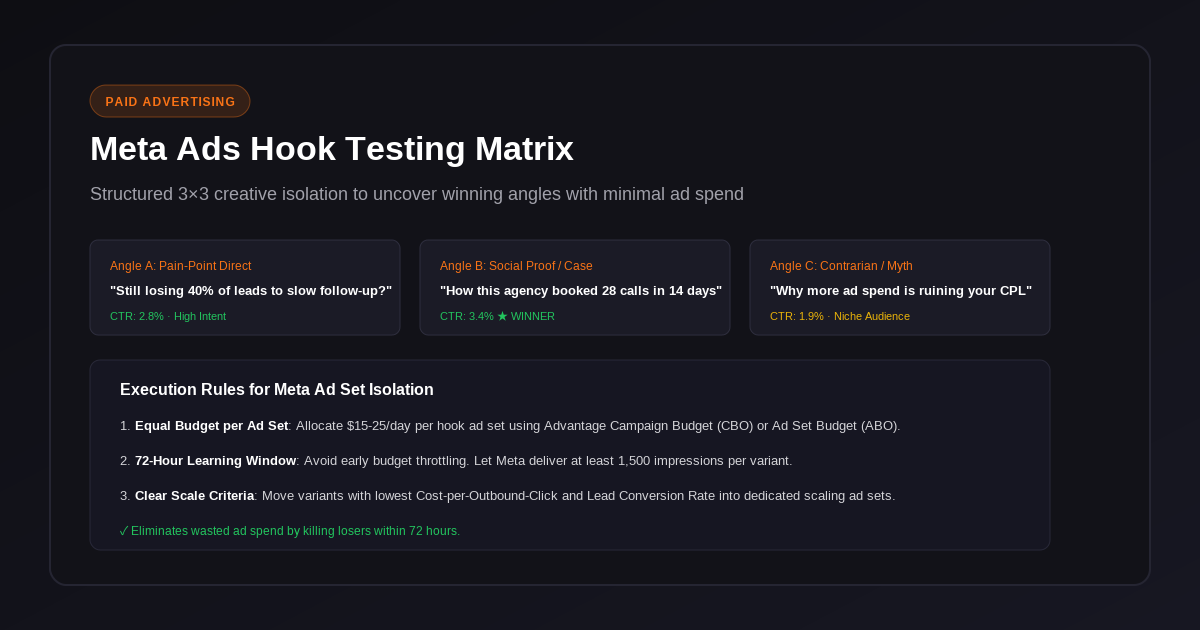
To achieve clean statistical significance without burning through client budget, I use a structured 3×3 Hook Testing Matrix.
1. The 3×3 Testing Architecture
In this system, audience targeting, landing page destination, and offer remain completely static. We isolate only the top 3-second hook of the ad creative.
The Three Testing Angles:
- Angle A: Direct Pain-Point Callout
- "Still losing 40% of leads because sales takes 4 hours to follow up?"
- Targets problem-aware users looking for immediate relief.
- Angle B: Case Study & Proof
- "How a Kathmandu consultancy generated 142 qualified student leads in 21 days."
- Leverages specificity and third-party validation.
- Angle C: Contrarian Myth Busting
- "Why spending more on Meta Ads is actually killing your conversion rate."
- Disrupts scroll behavior by challenging common assumptions.
2. Ad Account Campaign Setup
We structure our test campaign using Ad Set Budget Optimization (ABO) to enforce equal distribution:
Campaign: [TEST] - Dynamic Creative Sandbox
├── Ad Set 1: Broad / Interest Bucket ($15/day)
│   ├── Ad 1: Angle A (Pain Point)
│   ├── Ad 2: Angle B (Case Study)
│   └── Ad 3: Angle C (Contrarian)
Key Rules During the First 72 Hours:
- No Manual Tweaks: Let Meta deliver at least 1,500 impressions per ad before judging performance.
- Isolate Placements: Test on Instagram Reels and Facebook Feed where audio-visual hooks matter most.
- Fixed Budget: Never raise budget during the testing window; let cost-per-click stabilize.
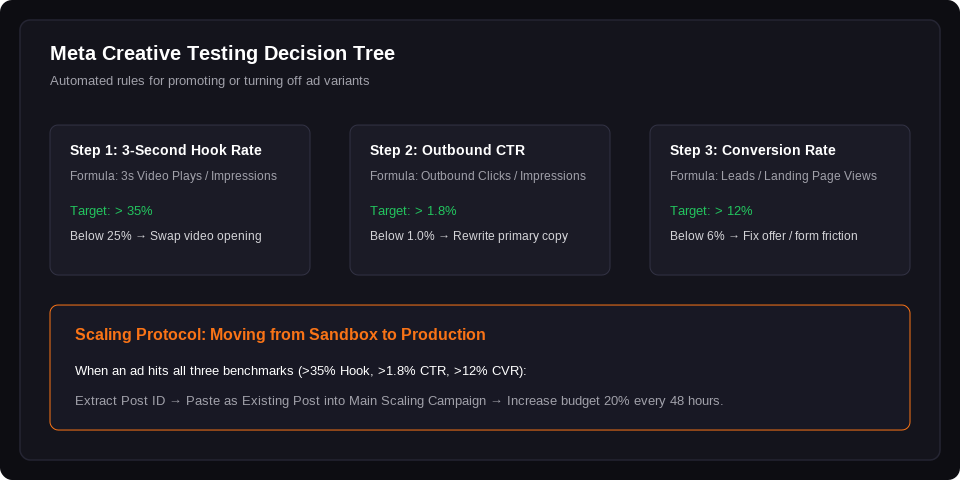
3. Evaluation Benchmarks & Graduation Rules
| Metric | Fail Threshold | Pass Benchmark | Action |
|---|---|---|---|
| 3-Second Hook Rate | Loading article content... |
Loading article content... |
If below 25%, swap first 3 seconds of video |
| Outbound CTR | Loading article content... |
Loading article content... |
If below 1.0%, rewrite body copy and CTA |
| Landing Page CVR | Loading article content... |
Loading article content... |
If below 6.0%, optimize landing page load speed & form fields |
| Cost Per Lead (CPL) | Above Target CPL | Below Target CPL | Graduated to Scaling Campaign |
4. Scaling the Winner
Once an ad proves it consistently beats the target CPL and maintains an Outbound CTR above 1.8%:
- Extract the post's Existing Post ID from Page Posts in Meta Business Suite.
- Duplicate the Post ID into your main Scaling Campaign (CBO).
- This preserves all existing social proof (likes, comments, and shares), ensuring machine learning algorithms continue building positive momentum.
- Scale the budget by 15% to 20% every 48 hours as long as return on ad spend (ROAS) remains above target.
This disciplined matrix turns ad creative from a guessing game into a predictable, repeatable growth system.