How AI Tools Accelerate Growth Campaign Testing
Modern growth marketing demands rapid experimentation and disciplined creative iteration across channels. Relying on gut feel or producing only one or two ad concepts a month leads to budget fatigue, inflated cost-per-acquisition, and slow feedback loops.
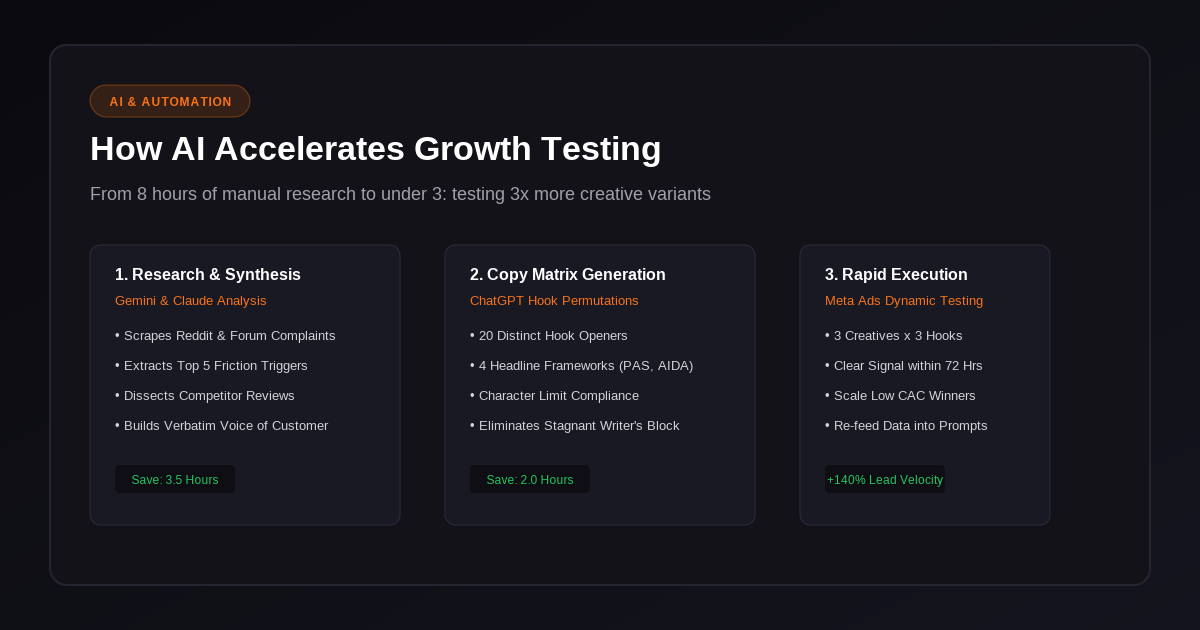
By integrating modern generative AI models into distinct phases of my workflow, I cut campaign launch preparation time from 8 hours down to under 3 hours, while testing triple the number of creative angles.
1. Tool Specialization: Right Model for the Right Task
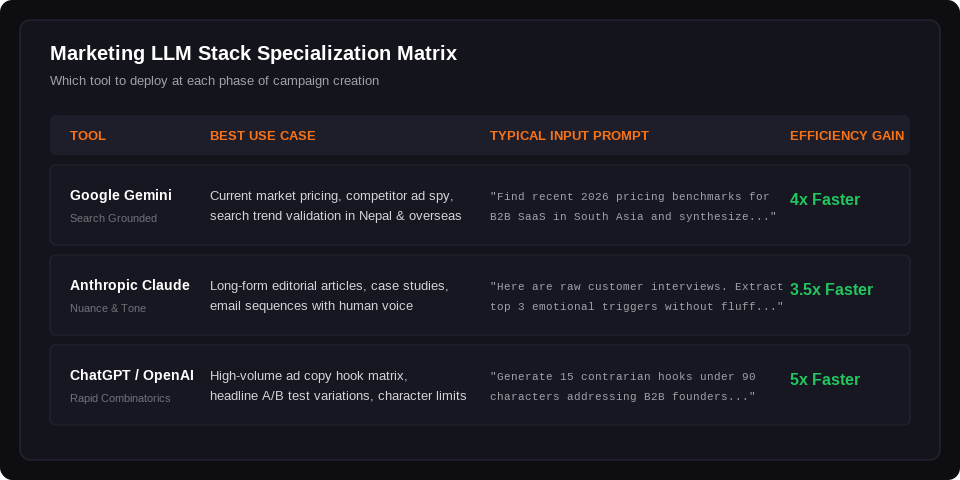
Not all language models excel at the same tasks. Instead of using a single tool for everything, I use a specialized stack:
Model Deployment Roles:
- Google Gemini: Real-time market research, competitive ad spying, and regional pricing validation grounded in live search data.
- Anthropic Claude: Deep persona synthesis, customer interview analysis, long-form editorial copy, and maintaining a natural human voice.
- OpenAI ChatGPT: Rapid combinatorics, churning 20+ hook variations under 90 characters, and headline A/B permutations.
2. Phase-by-Phase Workflow
Step 1: Voice-of-Customer Data Extraction (Claude)
We feed uncensored Reddit discussions, customer reviews, and feedback notes into Claude with this prompt template:
You are a senior direct-response copywriter.
Analyze the following customer reviews and extract:
1. The top 5 recurring friction points prospects complain about.
2. The exact emotional phrases they use when frustrated.
3. The "magic moment" where they realized the solution worked.
Avoid buzzwords. Return verbatim phrases whenever possible.
Step 2: The 20-Hook Matrix (ChatGPT)
Next, we feed the extracted pain points into ChatGPT to generate distinct hook angles across 4 copywriting frameworks:
- Problem-Agitate-Solve (PAS)
- Attention-Interest-Desire-Action (AIDA)
- Contrarian Belief Callout
- Before-After-Bridge (BAB)
Step 3: Asset Assembly & Creative Production
With hooks established, we generate ad scripts for short-form video (Reels/TikTok) and carousel slides. Design teams receive explicit direction on which hook matches which visual concept, eliminating back-and-forth ambiguity.
3. Results & Performance Impact
Implementing this systematic AI workflow across client ad accounts yielded measurable gains:
| Metric | Before AI System | With AI Workflow | Change |
|---|---|---|---|
| Weekly Hook Variants Tested | 4 – 6 variants | 18 – 24 variants | +300% |
| Campaign Prep Time | ~8 hours | ~2.5 hours | -68% |
| Creative Fatigue Rate | High (every 2 weeks) | Low (refreshed weekly) | Stabilized ROAS |
| First-Week Winner Discovery | 25% of tests | 65% of tests | +160% |
"AI won't replace growth marketers, but growth marketers who build systematic AI workflows will replace those who rely on manual guesswork."
Conclusion
The objective of AI in marketing is not to generate generic automated spam. The real power is speed of hypothesis testing. When you can research, write, and launch three times as many distinct angles in half the time, you find profitable customer acquisition channels significantly faster.